What is Ascending Order?
Ascending order means to arrange numbers in increasing order, that is, from smallest to largest.
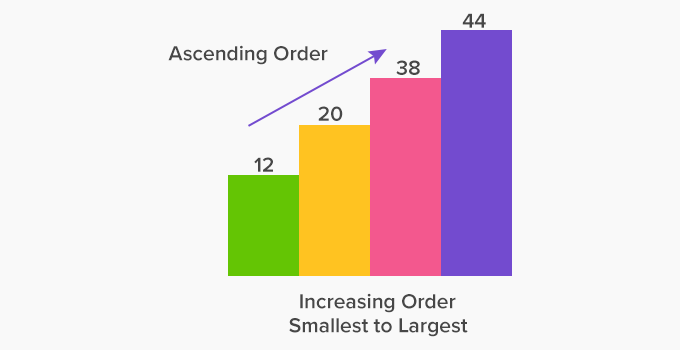
To arrange numbers in any order, we first need to compare them.
First Compare, then Order
Arranging numbers in ascending order:
- Count the number of digits in each number. The number with the least number of digits is the smallest. Write it first. Continue this till all the numbers left for comparison have the same number of digits.
- For the numbers having the same number of digits, start with comparing the numbers from the leftmost digit. Write the number with the smallest digit.
- If the leftmost digits are same, move to the digits to the right and compare them. Write the number with smaller digit.
- Continue doing this with the remaining numbers till we arrange all the numbers.
Example: Arrange 22554, 231, 22, 245, 22354 in ascending order.
The number 22 has the least number of digits. So, write it first as it is the smallest number.

Next, 231 and 245 both are 3-digit numbers. They both have 2 at hundreds place. So, we move to the digit to the right. Compare 231 and 245 Since,

Next, compare 22554 and 22354 as both have 5 digits. On comparing, 22554 and 22354, we find
So,

We can then also arrange the numbers on the number line as shown:
Ordering Fractions in Ascending Order
- Ordering fractions with same denominators
For the fractions having the same denominator, the fraction with the smallest numerator is the smallest.
Example: Arrange
Comparing the numerators, we get
Therefore,
- Ordering fractions with same numerators
When the fractions have the same numerator, the fraction with the highest denominator is the smallest.
Example: Arrange
Here, the numerator is 3 in all the fractions. So, we compare the denominator.
On comparing the denominators, we get:
Therefore,
- Ordering fractions with different numerators and denominators
Convert the fractions to the like denominators (or numerators) and then compare and order them.
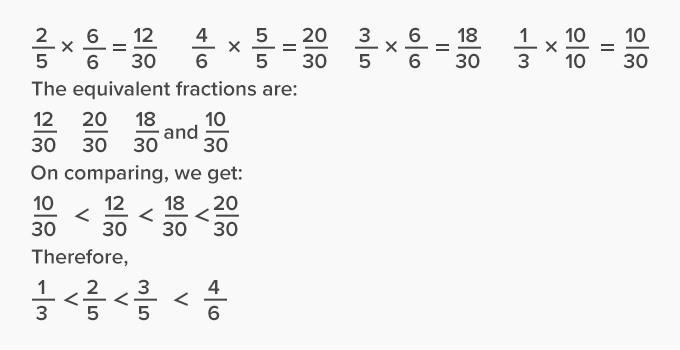
Example: Arrange
Here, the denominators are 5, 6 and 3.
LCM of 3, 5 and 6 is 30.
So, we find the equivalent fractions.
Ordering Decimals in Ascending Order
- First compare the whole number part in each decimal. The number with smallest whole number is the smallest.
- If the whole number parts are the same, compare the decimal parts just as we compare the whole numbers.
Example: Arrange 22.44, 22.04, 22.40, and 2.45 in ascending order.
First compare whole numbers:
22.44, 22.04, 22.40, and 2.45
2 is the smallest, we write it first.
| 2.45 |
22.44, 22.04, 22.40 all have 22.
So, compare the decimal parts.
Therefore,
The ascending order is:
| 2.45 | 22.04 | 22.40 | 22.44 |
| Fun Facts – To remember ascending order, remember the flight of an “airplane”, from low to high. |
No comments:
Post a Comment